Palmer Luckey Net Worth 2026: What $61B Really Means

Palmer Luckey first became widely known through Oculus VR, the headset startup Facebook acquired in 2014. A decade later, his name is attached to a Forbes estimate of approximately $5 billion, this time built almost entirely on paper, through his equity in Anduril, the private defense technology company he cofounded in 2017 and still helps lead as a board member and public face, though not as chief executive.
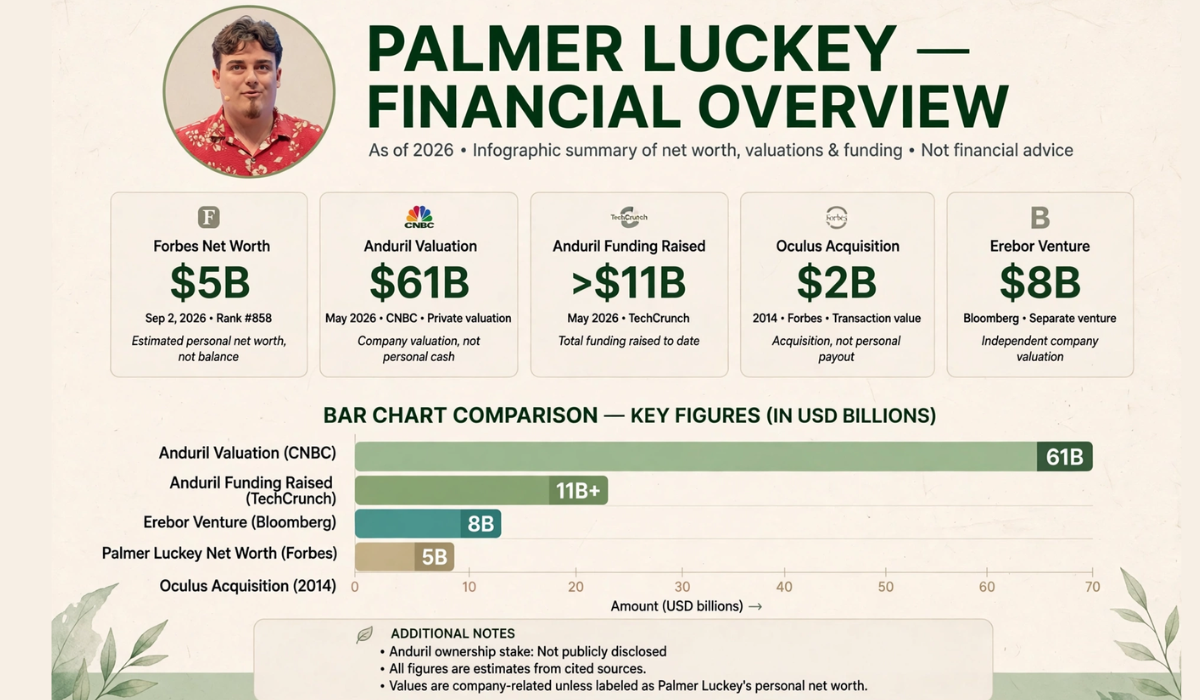
Forbes’ Real Time Billionaires tracker put Palmer Luckey net worth at $5 billion as of September 2, 2026, ranking him 858th in the world, according to the Forbes profile. That figure is a source estimated valuation of his private company equity, mainly in Anduril. Anduril’s own reported $61 billion valuation is not Luckey’s personal wealth, and his exact ownership stake, cash holdings, debt and illiquid assets are not publicly disclosed.
The Numbers That Matter
| Measure | Reported figure | Why it matters |
| Palmer Luckey’s Forbes estimate | $5 billion, as of September 2, 2026 (Forbes) | A source estimated personal net worth, not a disclosed balance |
| Anduril valuation | Approximately $61 billion in May 2026 (CNBC) | A private company valuation, not personal cash |
| Anduril funding raised | More than $11 billion by May 2026 (TechCrunch) | Shows investor support and explains the valuation climb |
| Oculus acquisition | Approximately $2 billion in 2014 (Forbes) | Transaction value, not Luckey’s personal payout |
| Anduril ownership stake | Not publicly disclosed | Prevents false personal wealth calculations |
| Erebor venture | Reported financing talks near an $8 billion valuation (Bloomberg) | A separate venture, not his disclosed personal wealth |
Key Takeaways
- Forbes’ $5 billion figure reflects a jump from about $3.5 billion before Anduril’s May 2026 funding round, tracking the company’s valuation rather than a change in his bank balance.
- Anduril’s $61 billion valuation, confirmed by CNBC and Bloomberg, doubled the company’s prior $30.5 billion mark from June 2025.
- Luckey’s Oculus sale, his Anduril equity, and his involvement in the newer Erebor venture are three separate financial stories that should never be added together into one figure.
- No reliable source discloses what percentage of Anduril Luckey currently owns, so any dollar figure built from the $61 billion valuation and a guessed stake is not verifiable.
- Palmer Luckey cofounded Anduril; Brian Schimpf serves as chief executive, according to the company’s own public materials.
A Headset Built In A Camper Trailer
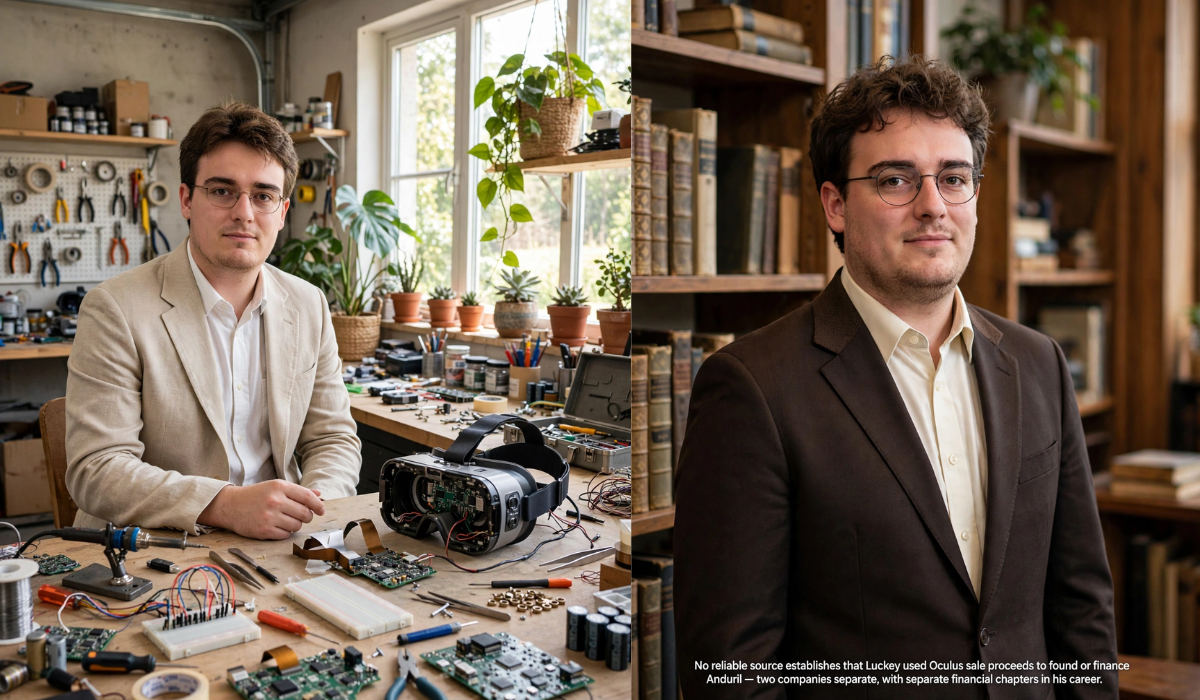
Palmer Luckey built the first working prototype of what became the Oculus Rift as a teenager, tinkering with salvaged parts before he ever ran a company. He and cofounders including Brendan Iribe formally launched Oculus VR in 2012 and turned to Kickstarter, where backer enthusiasm signaled that consumer virtual reality had real demand behind it.
In 2014, Facebook agreed to acquire Oculus for a transaction Forbes values at approximately $2 billion in cash and stock, a deal that made Luckey a household name in tech at just 21 years old.
Before the acquisition, id Software programmer John Carmack helped validate the technology by running a modified version of Doom 3 on an early prototype, a moment widely credited with drawing serious developer attention to the project. The Kickstarter campaign that followed raised far more than its goal, turning a hobbyist’s headset into a company investors wanted to back before Facebook ever came calling.
Oculus was acquired outright by Facebook, now Meta, in 2014. Luckey has held no ownership stake in Oculus since that sale closed, and his current wealth is tied to companies he founded afterward, not to the brand he sold.
Why A Two Billion Dollar Deal Is Not A Personal Payout
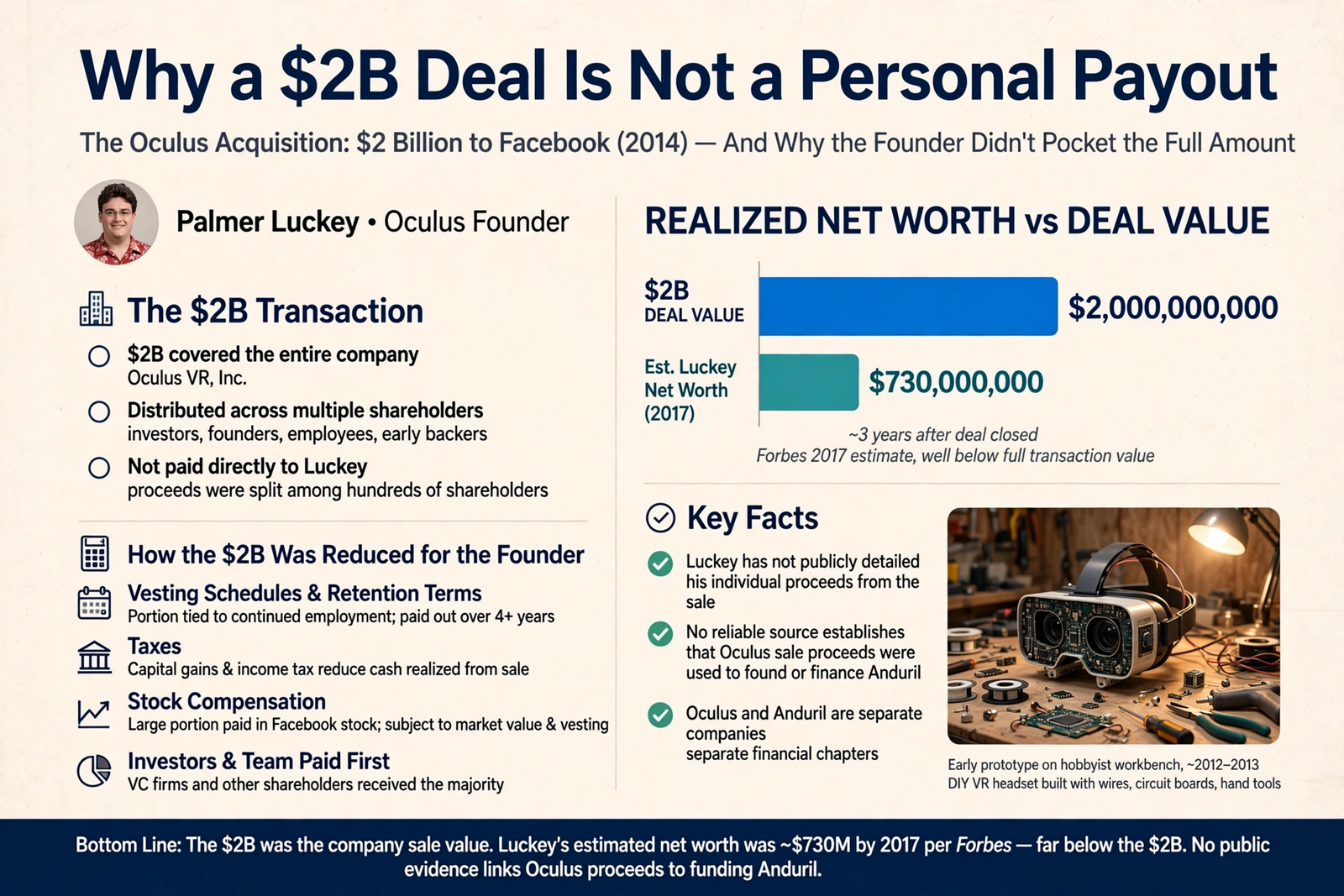
An acquisition price is not a check written to one person. Understanding that distinction matters more here than in almost any other founder story.
- The $2 billion figure covered the entire company, meaning it was distributed across multiple shareholders, not paid directly and entirely to Luckey.
- Deal mechanics such as vesting schedules, retention terms, and taxes on stock compensation typically reduce what a departing or remaining founder actually realizes in cash over time.
- Luckey has not publicly detailed his individual proceeds from the sale, and TechCrunch reported in 2017 that Forbes estimated his net worth at roughly $730 million three years after the deal closed, a figure well below the full transaction value.
- No reliable source establishes that Luckey used Oculus sale proceeds to found or finance Anduril; the two companies are separate financial chapters in his career.
Leaving Facebook Amid A Political Storm
Luckey left Facebook in 2016, three years after the Oculus deal closed, then 24 years old, according to TechCrunch’s reporting on his departure. Facebook’s official statement thanked him for his contributions but gave no explanation for the exit.
The departure followed months of scrutiny after The Daily Beast reported that Luckey had funded a pro Trump political group during the 2016 election, a story that drew public criticism from parts of the video game development community. A later Wall Street Journal report, relayed by The Daily Beast, said internal Facebook communications suggested his political donations played a role in the decision, though Facebook never confirmed that account publicly.
This article treats the episode as a documented business and political event rather than a verdict on Luckey’s character, since the exact internal reasoning behind his exit has never been officially confirmed by Facebook.
Virtual Reality To Defense Autonomy
Luckey cofounded Anduril in 2017 alongside Brian Schimpf, Trae Stephens, Matt Grimm and Joseph Chen, turning from consumer entertainment hardware to national security technology. Brian Schimpf serves as chief executive, while Luckey remains a cofounder and the company’s most public figure. The company builds autonomous systems, sensors and software platforms intended to help the US military and allied governments track threats and coordinate responses, rather than consumer products.
Anduril works with US defense agencies and allied governments on autonomous systems and other national security technologies. Specific contracts are described here only when supported by official government award notices or high quality reporting. Reporting from Sacra, a business research firm, notes that in March 2026 the US Army awarded Anduril a 10 year enterprise contract with a ceiling of up to $20 billion covering more than 120 separate procurement actions, a figure that represents maximum potential value rather than money already paid out.
This article does not detail classified programs or specific weapons capabilities beyond what these named, publicly reported contracts describe.
[IMAGE PLACEHOLDER: Photorealistic image of a modern technology operations room with wall mounted monitors displaying abstract radar style data visualizations, engineers reviewing screens at a control desk, cool blue lighting, full frame layout, no classified material or weapons imagery implied.] Alt text: Defense technology operations room illustration.
The Valuation Leap That Rewrote The Headline
Anduril’s valuation has climbed in stages. The company closed a $1.48 billion Series E round in December 2022 that valued it at $8.48 billion, according to Defense News, before a $1.5 billion Series F round pushed the valuation to $14 billion in August 2024, per Crunchbase News.
Anduril then raised $2.5 billion in a Series G round that doubled its valuation to $30.5 billion in June 2025, with Founders Fund contributing a $1 billion check, according to TechCrunch.
Less than a year later, Anduril raised $5 billion in a round led by Thrive Capital and Andreessen Horowitz, pushing its valuation to approximately $61 billion, CNBC and Bloomberg both confirmed in May 2026. TechCrunch reported the company had more than doubled its 2025 revenue to $2.2 billion, a growth story that helped justify investor appetite for the new round.
Private market funding rounds like this one move founder wealth estimates sharply because trackers like Forbes reprice a founder’s equity against the new valuation as soon as a deal closes. Forbes attributed Luckey’s jump from about $3.5 billion to $5 billion directly to this funding event. Exact ownership, any dilution from the new shares, and the rights attached to preferred stock in the deal are not public, so the precise mechanics behind that jump cannot be independently verified.
By July 2026, Anduril was reportedly in talks for another round that could push its valuation toward $100 billion, according to TechCrunch, part of a broader defense technology funding surge. The same report notes peers such as Shield AI, which raised $1.5 billion in March 2026, and Europe’s Helsing, which raised $1.8 billion at an $18 billion valuation around the same time. Anduril operates in this broader defense technology market alongside traditional contractors; these companies overlap in some autonomy and defense technology areas but are not identical businesses.
What A Sixty One Billion Dollar Valuation Does Not Mean
A headline valuation this large invites assumptions that are easy to make and usually wrong. The list below narrows the gap between the number and what it actually represents.
- It does not mean Anduril has $61 billion in cash sitting in a bank account, since a valuation reflects what investors agreed to pay for a slice of the company, not the company’s liquid assets.
- It does not mean Luckey personally holds anything close to that figure, since his ownership percentage is not public and has been diluted by every funding round since 2017.
- It does not mean the valuation is fixed, since private valuations are set at the moment of a funding round and can rise or fall sharply at the next one.
- It does not mean Anduril shares can be sold on demand, since the company remains private and has not completed a public listing.
- It does not account for preferred share rights that new investors often negotiate, which can entitle them to be paid before common shareholders like early employees in some scenarios.
- It does not reflect taxes, which would apply to any eventual sale of Luckey’s shares and are not factored into a headline valuation figure.
A New Venture Enters The Picture
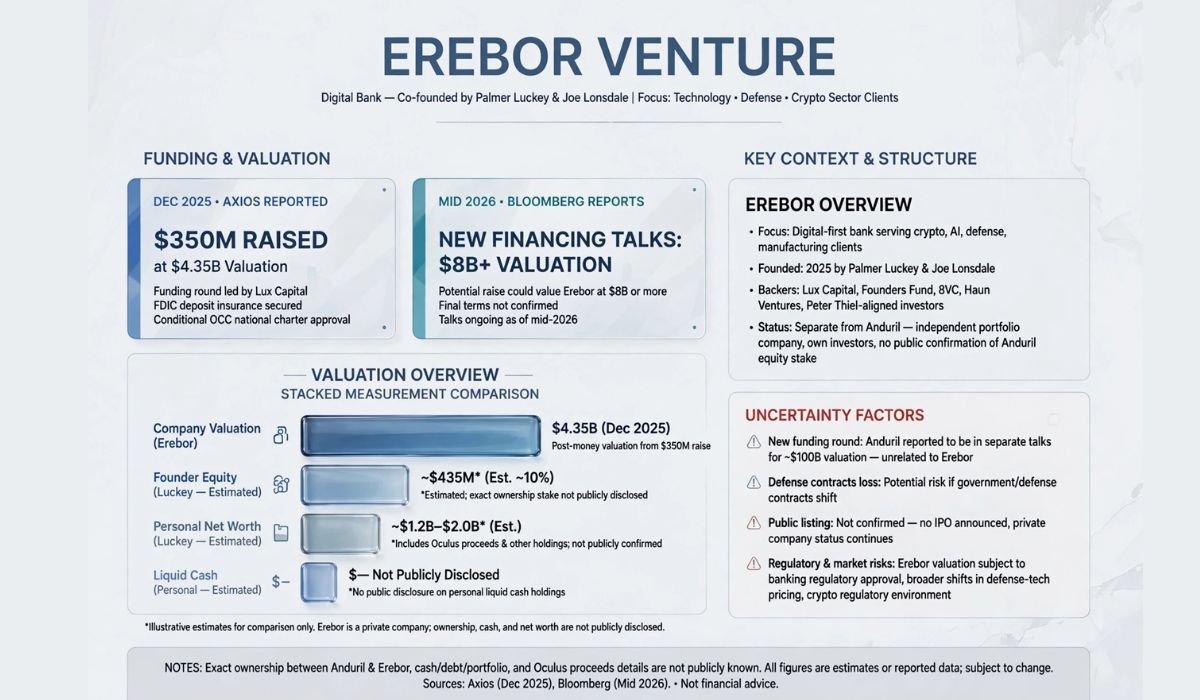
Luckey has also cofounded Erebor, a proposed digital bank venture focused on technology, defense and crypto sector clients, alongside Joe Lonsdale. Its regulatory status, ownership structure and operating timeline should be described only as confirmed by official regulators or company announcements. Axios reported that the venture raised $350 million at a $4.35 billion valuation in December 2025.
By mid 2026, Bloomberg reported that Erebor was in talks for new financing that could value the venture at $8 billion or more. Final terms of that round were not publicly confirmed at the time of this reporting.
Erebor is a separate business from Anduril, with its own investors, its own valuation history, and no public confirmation of how much equity Luckey holds in it.
The Uncertainty Behind Every Billion Dollar Estimate
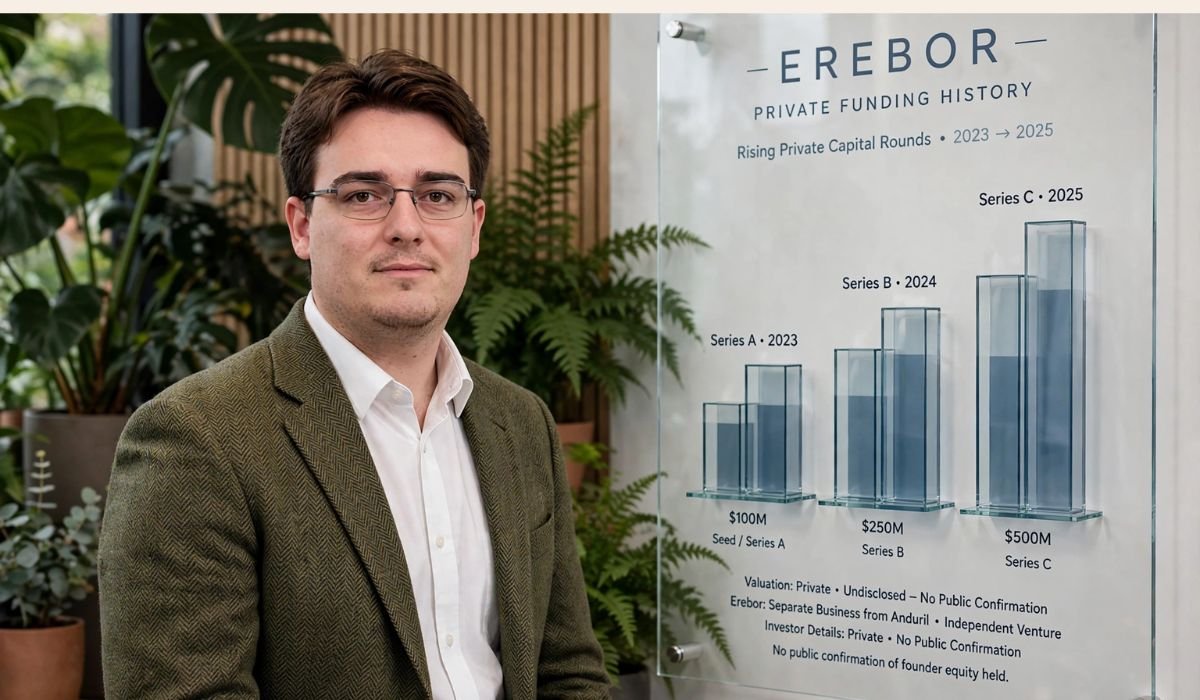
The single largest source of uncertainty in any Palmer Luckey net worth figure is the ownership structure that nobody outside Anduril, Erebor and their investors can see. Beyond that structural gap, several other factors could move the estimate in either direction.
What can change Palmer Luckey’s estimated net worth
- A completed new funding round at Anduril, which reporting suggests could value the company as high as $100 billion.
- Major new defense contracts or the loss of existing ones, since Anduril’s revenue growth has been central to its valuation story.
- A public listing at Anduril, which the company has not confirmed a timeline for, replacing private estimates with a continuously priced share value.
- Movement in Erebor’s valuation as its financing talks and regulatory standing evolve.
- Broader shifts in how investors price defense technology and private company equity generally.
What is not publicly known about Palmer Luckey’s finances
- His exact ownership percentage in Anduril.
- His ownership percentage in Erebor.
- His liquid cash holdings, personal debt, or investment portfolio outside these two companies.
- The precise amount he personally received from the 2014 Oculus sale.
- His current annual compensation, if any, from either company.
Regulatory and reputational factors add further exposure. Anduril operates in a sector shaped by shifting defense budgets, contracting cycles and political administrations, and defense procurement in particular tends to move in multi year cycles tied to federal budgets, so a change in administration priorities or a delayed appropriations process could slow contract awards even for a well positioned company.
Company valuation, founder equity, personal net worth and liquid cash are four different measurements, and collapsing them into one number is where most inflated wealth claims come from. A company’s valuation is what investors agreed to pay for a stake in the business at a specific moment.
Founder equity is the portion of that company a specific person owns, which is rarely disclosed for private founders. Personal net worth is an outside estimate of what that equity, plus any other assets, would be worth if converted to cash today. Liquid cash is the only one of the four that reflects money a person could actually spend right now, and it is also the one about which the least is publicly known in Luckey’s case.
Where The Wealth Story Stands Today
Palmer Luckey has now helped build two companies that reached double digit billion dollar valuations without either one going public. That is a meaningfully different kind of wealth than an entrepreneur whose fortune rises and falls with a daily traded stock price.
For comparison, Elon Musk’s net worth is more visibly affected by public company share prices, whereas Luckey’s headline figure depends mainly on less transparent private market valuation assumptions. Luckey’s wealth, by contrast, is an estimate built on the last price outside investors agreed to pay for Anduril, a figure that could be meaningfully different the next time the company raises money, sells shares, or goes public.
A Rough Timeline Of How The Number Got Here
- In 2012, Oculus VR founded and launched its Kickstarter campaign.
- In 2014, Facebook acquired Oculus for approximately $2 billion in cash and stock.
- In 2016, Luckey departed Facebook following a period of public scrutiny.
- In 2017, Luckey cofounded Anduril with Brian Schimpf, Trae Stephens, Matt Grimm and Joseph Chen.
- December 2022, Anduril raises $1.48 billion at an $8.48 billion valuation.
- August 2024, Anduril raises $1.5 billion at a $14 billion valuation.
- June 2025, Anduril raises $2.5 billion at a $30.5 billion valuation, led by Founders Fund.
- December 2025, Erebor raises $350 million at a $4.35 billion valuation.
- In May 2026, Anduril raised $5 billion at a $61 billion valuation, led by Thrive Capital and Andreessen Horowitz.
- September 2, 2026, Forbes lists Luckey’s real time net worth at $5 billion.
How The Money Actually Connects
Oculus VR founding and Facebook acquisition, then a separate chapter in Luckey’s technology career, then Anduril cofounded in 2017 with a separate founding team, then private funding rounds and higher company valuations, then Forbes’ estimate of Luckey’s equity linked wealth. This diagram shows career chronology only; it does not establish that Oculus sale proceeds funded Anduril.
Four Figures, Four Different Meanings
| Figure | Date | What it represents | What it does not represent |
| Oculus acquisition | 2014 | The total transaction value Facebook paid for the company | Palmer Luckey’s individual cash payout |
| Anduril valuation | May 2026 | What investors agreed to pay for a stake in the private company | Palmer Luckey’s personal wealth |
| Forbes personal estimate | September 2, 2026 | A source estimated figure for Luckey’s equity linked net worth | An audited or disclosed balance sheet |
| Erebor reported valuation | 2026, in talks | A separate venture’s private financing valuation | Any confirmed personal stake belonging to Luckey |
Frequently Asked Questions
What is Palmer Luckey’s net worth in 2026?
Forbes listed his real time net worth at $5 billion as of September 2, 2026. That figure reflects estimated private company equity, mainly in Anduril, and does not represent disclosed cash holdings.
How did Palmer Luckey make his money?
He founded Oculus VR, which Facebook acquired in 2014, then cofounded Anduril Industries in 2017. His current wealth estimate is driven almost entirely by Anduril’s rising private valuation, not by the Oculus sale.
What is Anduril worth in 2026?
Anduril was valued at approximately $61 billion following a May 2026 funding round led by Thrive Capital and Andreessen Horowitz. That figure is a company valuation, not Luckey’s personal net worth.
Is Anduril publicly traded?
Anduril is private and its shares are not generally available to public investors. No completed Anduril IPO was confirmed in the sources reviewed for this article.
How much did Palmer Luckey make from the Oculus sale?
Not publicly disclosed. The deal valued Oculus at roughly $2 billion overall, but that figure was split among shareholders; Forbes estimated Luckey’s net worth at about $730 million three years later.
What percentage of Anduril does Palmer Luckey own?
Not publicly disclosed. No credible current source confirms an exact ownership percentage, so his stake cannot be calculated from Anduril’s $61 billion valuation.