
Johannes von Baumbach Net Worth 2026: Boehringer Ingelheim & the World’s Youngest Billionaire

Johannes von Baumbach’s estimated 2026 net worth is approximately $6.5 billion to $6.6 billion, according to Forbes-linked trackers. His fortune comes from an inherited stake in Boehringer Ingelheim, one of the world’s largest privately held pharmaceutical companies, controlled by his family for more than a century.
He held the title of world’s youngest billionaire through 2025, but by early 2026 it moved to a Brazilian heir, Amelie Voigt Trejes, who is reported to be younger by roughly seven weeks. This is inherited, estimated private-company equity, not confirmed liquid cash.
Key Takeaways
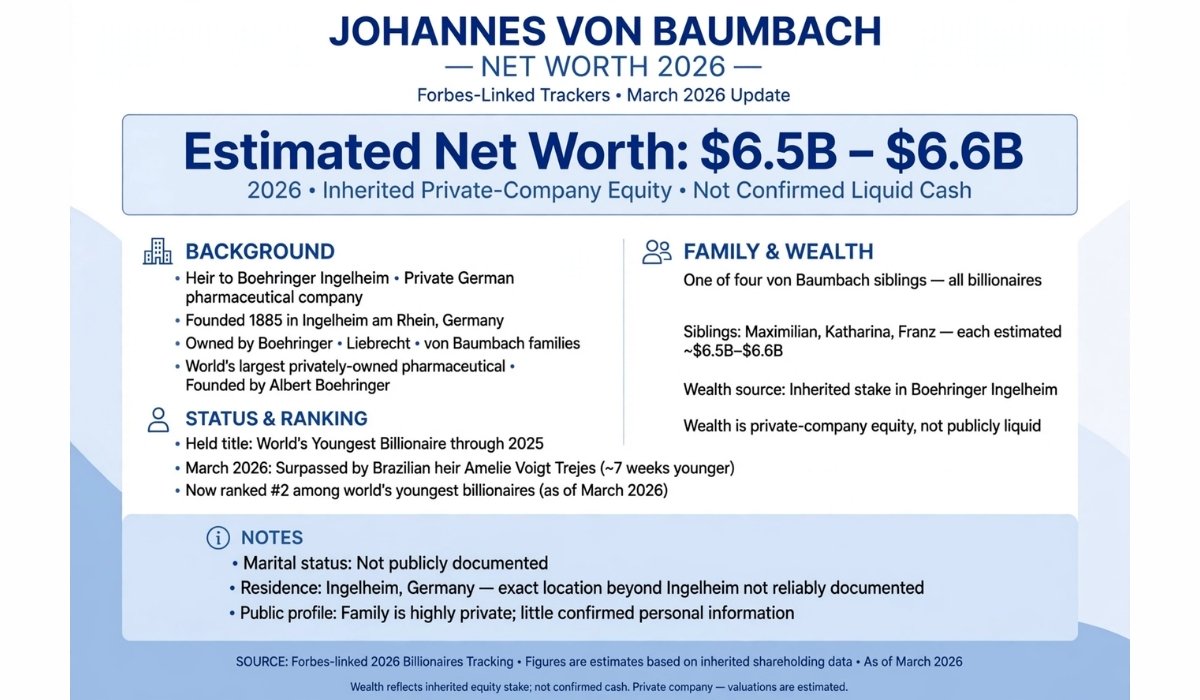
- Johannes von Baumbach net worth’s 2026 is estimated at approximately $6.5 billion to $6.6 billion, according to Forbes-linked trackers, making him one of the wealthiest young heirs on any current billionaire list.
- His fortune comes from an inherited stake in Boehringer Ingelheim, a private German pharmaceutical company founded in 1885 and still owned by the Boehringer, Liebrecht and von Baumbach families.
- He held the title of world’s youngest billionaire through 2025, but by Forbes’ March 2026 rankings, Brazilian heir Amelie Voigt Trejes, reported to be about seven weeks younger, had taken the position.
- Johannes von Baumbach siblings is one of four , all reportedly billionaires through the same family stake, with his three older siblings each worth a comparable amount.
- His marital status and exact residence beyond Ingelheim, Germany, are not reliably documented in public sources.
Where Johannes von Baumbach’s Fortune Comes From
Johannes von Baumbach did not build a company, launch a product, or take part in a public offering. His fortune exists because his family has owned a majority stake in one of Europe’s oldest pharmaceutical companies since before either World War.
The Boehringer Ingelheim Connection
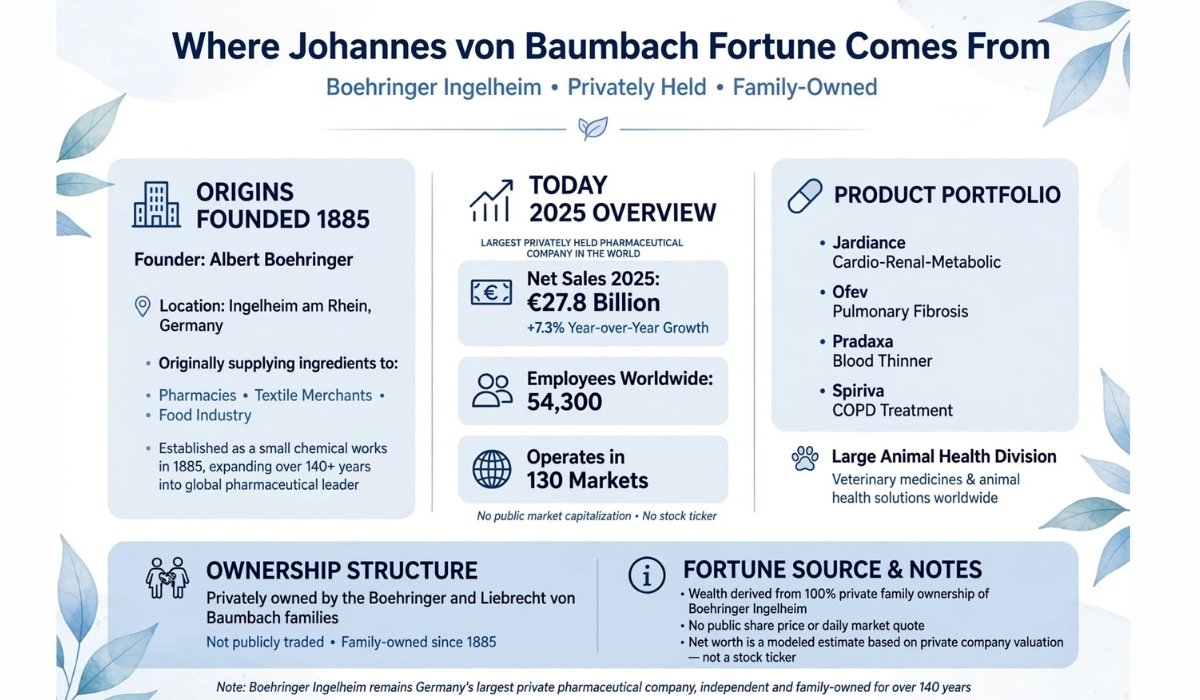
Boehringer Ingelheim was founded in 1885 by Albert Boehringer in the town of Ingelheim am Rhein, Germany, originally supplying ingredients to pharmacies, textile merchants and the food industry, according to Iconic Billionaires’ profile of Johannes von Baumbach.
More than 140 years later, the company has grown into the largest privately held pharmaceutical company in the world, with no public market capitalization at all, according to industry revenue rankings published by OneDayAdvisor, still headquartered in the same small German town where it began.
A few facts about the company explain why its private ownership structure matters so much to how Johannes’s wealth gets estimated in the first place.
- Boehringer Ingelheim reported group net sales of approximately €27.8 billion in 2025, up 7.3 percent year over year, and employs roughly 54,300 people worldwide, according to figures compiled on Wikipedia’s entry for the company.
- The company remains privately owned by the Boehringer, Liebrecht and von Baumbach families, rather than being publicly traded on any stock exchange.
- Its best-known current products include Jardiance, a cardio-renal-metabolic drug, Ofev for pulmonary fibrosis, and older blockbusters like Pradaxa, a widely prescribed blood thinner, and Spiriva, used to treat chronic obstructive pulmonary disease, alongside a large animal health division.
- The business operates in roughly 130 markets worldwide, according to Iconic Billionaires’ profile of the family.
Because Boehringer Ingelheim has no public share price, there is no daily market quote anyone can point to and multiply by an ownership percentage, unlike a listed company. That single structural fact is the reason every net worth figure attached to Johannes von Baumbach’s name is a modeled estimate rather than a number pulled directly from a stock ticker.
A Company Older Than Any Living Von Baumbach
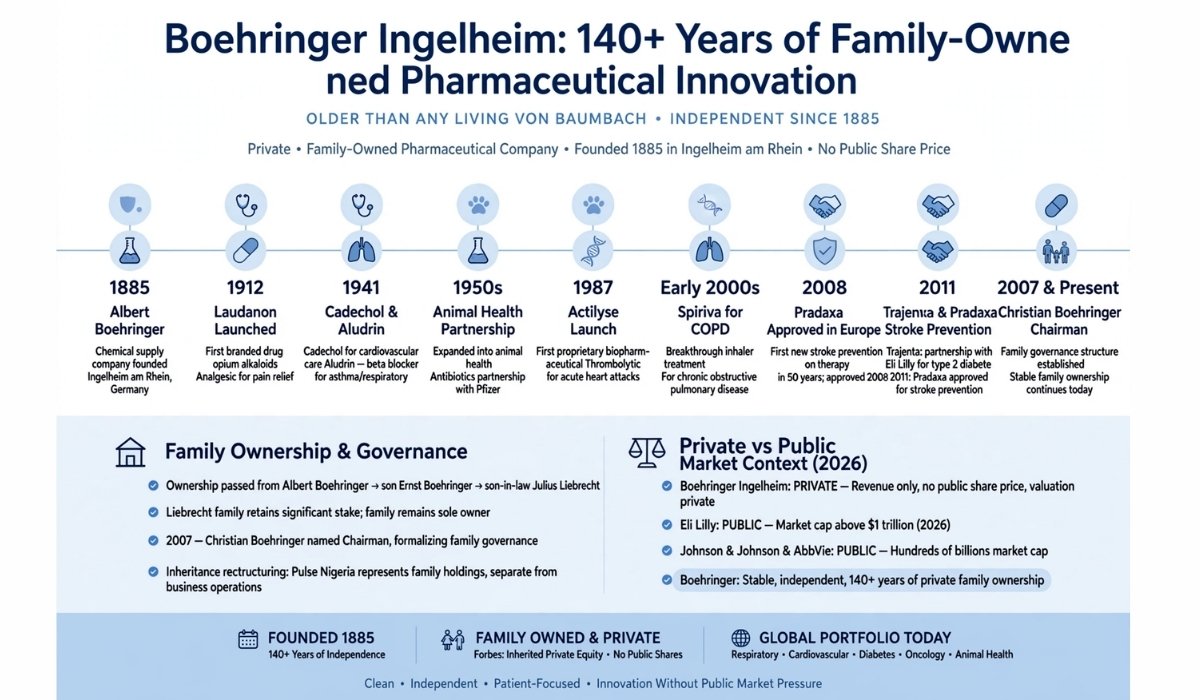
The company’s own history, published on Boehringer Ingelheim’s official history pages, traces a direct line from Albert Boehringer’s original chemical supply business to the pharmaceutical giant that funds the family’s current fortune.
Its first branded drug, Laudanon, an analgesic made from opium alkaloids, launched in 1912, followed by the cardiovascular drug Cadechol and the respiratory drug Aludrin in 1941, which the company credits with paving the way for later asthma treatments including beta blockers.
Ownership passed out of Albert Boehringer’s hands directly after his death shortly following the company’s 50th anniversary; his sons Albert and Ernst Boehringer took over alongside his son-in-law, Julius Liebrecht, which is the historical origin of the Liebrecht family’s continued ownership stake today.
The company’s animal health division began in the 1950s through an antibiotics distribution partnership with Pfizer, and its move into biopharmaceuticals accelerated in 1987 with Actilyse, the company’s first proprietary product developed at its own biopharmaceutical production site and the first thrombolytic treatment approved for acute heart attacks.
More recent history explains where today’s revenue actually comes from. Spiriva launched in the early 2000s for COPD, Pradaxa received Europe-wide approval in 2008 and a landmark stroke-prevention approval in 2011, described by the company as the first new approval of its kind in fifty years, and a partnership with Eli Lilly brought Trajenta to market in 2011 for type 2 diabetes. Jardiance and Ofev, now among the company’s largest products by sales, both launched in 2014.
Leadership of the shareholders’ committee has also stayed close to the founding families: Christian Boehringer, a direct descendant of the founder, became chairman in January 2007, according to a Zippia summary of the company’s corporate history, underscoring how tightly family governance and family wealth remain linked at this company compared with a typical public pharmaceutical giant.
How Inheritance Created His Wealth
Johannes’s wealth traces back to a restructuring of the family’s ownership shares, according to Pulse Nigeria’s coverage of his rise to billionaire status, rather than to any business he started or grew himself. Because Boehringer Ingelheim is privately owned, the family itself controls who receives which shares and when, giving the von Baumbachs far more discretion over succession than a founder of a publicly traded company would have.
That distinction matters for how readers should interpret his billionaire status. He did not identify a market opportunity, raise capital, or compete against rivals to build value from nothing; he became a shareholder in a business that was already generating billions of euros in annual revenue before he was born.
Forbes’ own profile lists his source of wealth simply as “Pharma,” a category shorthand that, in his case, means inherited private equity in a family pharmaceutical group rather than personal entrepreneurship.
Why a Private Pharma Fortune Is Different
Most of the household-name pharmaceutical giants that dominate headlines are publicly traded, which makes Boehringer Ingelheim, and by extension Johannes’s fortune, an unusual case worth explaining on its own terms.
Private Ownership Versus a Public Stock Price
Public pharmaceutical companies like Eli Lilly, Johnson & Johnson and AbbVie report their value in a market capitalization that updates every second the market is open; Eli Lilly alone carried a market cap above $1 trillion in 2026, according to AlphaSense’s ranking of pharmaceutical companies by market cap, with Johnson & Johnson and AbbVie both valued in the hundreds of billions. None of that applies to Boehringer Ingelheim, which discloses annual revenue but, by design, no public share price or market capitalization at all.
That structural difference is precisely why Johannes’s net worth estimates carry more uncertainty than, say, an heir to a large public drugmaker would. A public company’s shareholders can be valued to the cent based on the day’s closing price; a private company’s shareholders can only be estimated by applying an assumed valuation multiple to disclosed revenue, then guessing at how ownership is actually split among family members, none of which Boehringer Ingelheim is obligated to confirm publicly.
Family-controlled ownership also tends to be far more stable than public shareholding, since it isn’t subject to takeover bids, activist investors or quarterly earnings pressure in the same way a listed company is, which is part of why the Boehringer, Liebrecht and von Baumbach families have kept the business intact for over 140 years without ever selling shares to outside investors.
How Johannes Became the World’s Youngest Billionaire

The title of world’s youngest billionaire moves often, sometimes by a matter of weeks between two people born the same year, and Johannes’s own time holding it illustrates exactly how fragile that record can be.
The Shifting Title

Johannes was named the world’s youngest billionaire at 19 or 20, depending on the source and the exact date of the report, taking the title from Kevin David Lehmann, the German heir to the dm-drogerie markt drugstore chain, who had become a billionaire at 18 in 2021 through his own family inheritance, according to Pulse Nigeria’s report on the title’s history.
Before Lehmann, the title had already passed through several other young heirs in preceding years, a pattern that underscores how routinely this specific record changes hands as new heirs cross the billion-dollar threshold or existing titleholders simply have a birthday. Johannes held the title through most of 2025, with Unilad reporting in October of that year that he was 20 years old at the time.
By Forbes’ 2026 World’s Youngest Billionaires list, the record moved again. Forbes named Brazilian heir Amelie Voigt Trejes, of the WEG industrial family, as the new youngest billionaire at 20, reporting that she was younger than Johannes by roughly seven weeks. That makes him the second-youngest currently on record rather than the outright youngest, a distinction this article states plainly rather than repeating an outdated claim.
For context on how quickly these rankings shift among unrelated heirs, StarWealthInsider’s own coverage of a comparably young public figure, Jordy Bahl’s net worth, shows a similar pattern of headline wealth attention outpacing how often the underlying numbers actually change.
His Age and Background
Johannes’s exact age is reported inconsistently across sources: Forbes’ own profile lists him as 21, while other outlets from 2025 described him as 19 or 20 at the time of writing, consistent with a birth year of roughly 2005 or 2006.
He is reported to reside in Ingelheim, Germany, the same town where Boehringer Ingelheim was founded and remains headquartered, and holds German citizenship according to his Forbes profile. He is one of four von Baumbach siblings, and outside of his family’s business interests, Unilad has reported that he competes in skiing events in Austria.
Johannes von Baumbach’s Net Worth in 2026

Because Boehringer Ingelheim is private, estimating any individual family member’s net worth requires more assumptions than a comparable stake in a public company would. That is worth keeping in mind before comparing figures across different trackers.
The 2026 Estimates
The table below lays out what different outlets have reported for 2026, rather than treating any single number as definitively correct.
| Source | Estimated Figure | Date | What It Measures | Reliability |
|---|---|---|---|---|
| Forbes real-time profile | Ranked #623 on Forbes’ 2026 Billionaires list | Checked August 2026 | Official Forbes ranking, exact dollar figure not shown in the profile snapshot reviewed | High, official Forbes tracker |
| Iconic Billionaires | Approximately $6.6 billion, global rank #611 | Mid-2026 | Estimated inheritance-linked fortune | Secondary, lower confidence than Forbes |
| WealthRank | Approximately $6.5 billion, global rank #612 | August 16, 2026 | Estimated wealth, aggregated from Forbes-linked data | Secondary tracker citing Forbes |
The two secondary trackers land within about $100 million of each other, which for a private-company estimate this large counts as close agreement rather than meaningful disagreement.
Why the Figures Vary
Unlike a shareholder in a listed company, nobody outside Boehringer Ingelheim’s ownership group knows precisely what internal valuation the family uses for its own shares, so every outside estimate is built on assumptions about the company’s overall worth and how ownership is split among family members.
Trackers generally start from Boehringer Ingelheim’s reported revenue and apply an industry valuation multiple typical of large private pharmaceutical companies, then divide the resulting estimate across the known family shareholders, which introduces two separate layers of estimation before any number is even attached to Johannes specifically.
That modeling approach explains why his figure has moved noticeably over the past year, from roughly $5.6 billion in 2025, according to Brand Vision’s profile of him, to the $6.5 billion to $6.6 billion range reported in 2026. Some of that increase likely reflects real growth in Boehringer Ingelheim’s underlying business, and some of it reflects trackers refining their valuation multiples or ownership assumptions, and outside observers cannot cleanly separate the two.
None of these figures account for German inheritance or wealth taxes, family buy-sell agreements that may restrict when shares can change hands, or the basic illiquidity of owning stock in a company that has never had, and may never have, a public offering.
The Boehringer Ingelheim Family Fortune

Johannes’s individual net worth is only one piece of a much larger family fortune spread across multiple relatives and, further back, multiple founding families entirely.
The Von Baumbach Legacy
The von Baumbach family has been connected to Boehringer Ingelheim’s ownership for more than 130 years, according to Pulse Nigeria’s reporting on the family’s history, though the company’s leadership has not always sat with a von Baumbach directly. Unilad reported in 2025 that the company had been led by Hubertus von Baumbach, a relative of Johannes, since 2015, while the company’s own history records show shareholder-committee leadership passing through descendants of all three founding families over the decades, including Christian Boehringer’s appointment as chairman in 2007. Ownership and day-to-day management are not the same thing at Boehringer Ingelheim, in the same way that being a family shareholder does not require holding an operating title.
Family and Siblings
Johannes is one of four von Baumbach siblings, with his three older siblings reported to be 24, 26 and 27 years old as of late 2025, each said to be worth an amount comparable to his own fortune through the same family stake, according to Unilad’s reporting.
The family is described across multiple sources as notoriously private, and it remains unclear from public reporting whether Johannes or any of his siblings hold formal roles within the company itself. That combination of significant inherited wealth and almost no public profile is unusual even by the standards of other young billionaire heirs, most of whom at least appear in a handful of interviews or company materials.
Johannes von Baumbach’s Personal Life
Public interest in young billionaires often extends into their personal lives, and Johannes’s is among the least documented of any current billionaire under 30.
His Marital Status
No reliable public source reviewed for this article confirms whether Johannes von Baumbach is married. This article does not repeat unverified social media claims or speculation on this point, and no spouse or partner is documented in the sources checked here.
Where He Lives
Forbes’ official profile lists his residence as Ingelheim, Germany, the town where Boehringer Ingelheim is headquartered. Beyond that general location, his precise current address is not reliably documented, and this article does not speculate further about his home or daily life.
Johannes von Baumbach Net Worth in 2025 Compared With 2026
His reported fortune has grown noticeably over the past year, though it is worth separating genuine business growth from analysts simply refining their estimates.
The Wealth Timeline
| Period | Estimated Wealth | Source | Notes |
|---|---|---|---|
| Roughly 2024 | Just past $1 billion | Pulse Nigeria | First reported as reaching billionaire status |
| 2025 | Approximately $5.6 billion to $5.7 billion | Brand Vision, Unilad | Held the title of world’s youngest billionaire for much of the year |
| October 2025 | Approximately $5.7 billion, shared with three older siblings | Unilad | All four von Baumbach siblings reported at a similar figure |
| March 2026 | Ranked among Forbes’ World’s Youngest Billionaires 2026 | Forbes | Lost the youngest-billionaire title to Amelie Voigt Trejes by about seven weeks |
| August 2026 | Approximately $6.5 billion to $6.6 billion | Iconic Billionaires, WealthRank | Current range from secondary trackers |
No reputable source reviewed for this article reports a specific figure outside this timeline, so none has been added to fill a gap.
Why Johannes von Baumbach’s Story Matters
Johannes’s story is less about him personally than about what it reveals regarding how private, family-controlled fortunes get estimated and reported in the first place.
The Inherited Wealth Question
Every figure attached to his name depends on assumptions about a company that has never opened its books to public shareholders, which is a fundamentally different situation from an heir to a publicly traded business whose stake can be checked against a daily closing price. That distinction is worth remembering whenever a headline states his net worth as though it were as precise as a stock quote, and it is a large part of why this article has repeatedly flagged his figures as modeled estimates rather than confirmed facts.
It is also worth placing his story alongside very different paths to extreme wealth. Where Johannes’s fortune comes entirely from a family shareholding structure built up over five generations, someone like Luke Nosek’s net worth reflects wealth built through early technology company founding and venture investing, a genuinely self-made path rather than an inherited one. At the very top of the wealth spectrum, StarWealthInsider’s profile of Elon Musk’s net worth shows a fortune many multiples larger than Johannes’s, built through operating roles at multiple public companies rather than a private family holding, which underscores just how differently “billionaire” can be earned depending on the person behind the number.
Common Questions About Johannes von Baumbach’s Fortune
These are the questions people most often search alongside his name, and each deserves a direct, dated answer.
Who Is the Youngest Billionaire in the World?
As of Forbes’ March 2026 rankings, the title belongs to Brazilian heir Amelie Voigt Trejes, who inherited a stake in the industrial company WEG and is reported to be roughly seven weeks younger than Johannes von Baumbach. He held the title himself through most of 2025 before losing it, so current coverage still describing him as the youngest billionaire reflects an outdated snapshot rather than the most recent ranking, and this article corrects that record explicitly rather than repeating it.
How Old Is Johannes von Baumbach?
His age is reported inconsistently, with Forbes’ own profile listing him as 21 while earlier 2025 coverage described him as 19 or 20, consistent with a birth year of roughly 2005 or 2006. No single authoritative source pins down his exact birth date, so this article presents his age as a reported range rather than a fixed number.
Where Did Johannes von Baumbach Get His Money?
His fortune comes from an inherited stake in Boehringer Ingelheim, the private German pharmaceutical company his family has controlled for more than 130 years, following a restructuring of the family’s ownership shares. He did not build the company himself; the company itself dates back to 1885, more than a century before he was born, and has been owned continuously by descendants of its three founding families ever since.
Is Johannes von Baumbach Married?
No reliable public source reviewed for this article confirms his marital status, and this article does not repeat unverified claims about a spouse or partner. Johannes Von Baumbach family’s general preference for privacy, noted across multiple profiles of him, likely explains why so little about his personal life circulates in reliable reporting.
What Does Johannes von Baumbach Own?
His known asset is an inherited ownership stake in Boehringer Ingelheim, alongside three older siblings who reportedly hold comparable stakes through the same family holding structure. No public source reviewed for this article documents other major personal holdings, businesses or real estate in his name, and this article does not speculate about assets that have not been publicly reported.
Who Is the Heir to Boehringer Ingelheim?
Boehringer Ingelheim remains owned by the Boehringer, Liebrecht and von Baumbach families collectively, rather than by a single heir. Johannes is one of several current-generation heirs, alongside his three older siblings and other relatives across the three founding families, a structure that traces back to founder Albert Boehringer’s own children and son-in-law inheriting the company in the 1930s.
How Rich Is Johannes von Baumbach?
Secondary trackers place his 2026 net worth at approximately $6.5 billion to $6.6 billion, based on estimates of Boehringer Ingelheim’s overall value and his family’s ownership share. This is a modeled estimate rather than a figure drawn from a public stock price, since the company is privately held and discloses no market capitalization.
Is Johannes von Baumbach the Youngest Billionaire?
Not currently. He held that title through 2025, but Forbes’ March 2026 rankings list Amelie Voigt Trejes as younger by roughly seven weeks, making him the second-youngest currently on record rather than the outright youngest. Given how often this specific title has changed hands since 2021, readers should expect it to move again before long.